

Introduction
Rivers, since the time as we know have been integral part of human civilisation. They not only provide life and livelihood but are also associated spiritually and culturally. India, that is Bharat, rich in culture, traditions and history, has a total of approx. 400 rivers which support all forms of life situated in and around them. Among all of them, there are few rivers who are considered the most prominent ones and hold very high position in the Hindu religion. The holy trinity of river Ganga, Yamuna and Sarasvati are the of the highest significance. These three rivers are given the stature of goddesses in the Hindu religion and are worshipped with all piety and they find mentions in many of our prayers evoking these goddesses, singing hymns in their praises. Whereas rivers Ganga and Yamuna are fairly renowned and famous of the three, very little is known about the mysterious river Sarasvati. There are various contradictions about its origin, path of flow, its vastness and even its existence. Nevertheless, Sarasvati holds the position of extremely high importance in the Hindu culture. She is considered the Goddess of knowledge, as it believed that she had inspired the hymns and shlokas of Rig Veda. As the story goes, the Rig Veda was composed in the banks of River Sarasvati.
There have been few studies conducted on the river Sarasvati by some prominent historians and geologists. One such researcher is Michel Danino, a historian of French origin who has been studying Indian civilisation and culture since the age of twenty-one. Of the several books authored by him, ‘The Lost River – On the Trail of the Sarasvati’ especially focuses on uncovering the truth and important details of river Sarasvati.
Discovering the Lost River
Imám me gange yamune sarasvati Sútudri stómam sacata párusny á l asiknya marudvrdhe vitástayárjikiye Srnuhy á susómaya ll trstámaya prathamám yátave sajúh susártva rasáya svetyá tyá | tam sindho kúbhaya gomatim krúmum mehatnva sarátham yabhir iyase ||
O Ganga, Yamuna, Sarasvati, Shutudri (Sutlej), Parushni (Ravi), hear my praise! Hear my call, O Asikni (Chenab), Marudvridha (Maruvardhvan), Vitastã (Jhelum) with Arjikiya and Sushomä.
First you flow united with Trishtäma, with Susartu and Rasa, and with Svetya, O Sindhu (Indus) with Kubhä (Kabul) to Gomati (Gumal or Gomal), with Mehatnü to Krumu (Kurram), with whom you proceed together.
– Nadistuti Sukta, Rig Veda 10.75.5
Sarasvati is said to have a strong connection with the Harappan civilisation. Along with Indus, Sarasvati too was the cradle of the people of Harappan settlements as the excavations have proved. In fact, the river Sarasvati is believed to have been considered very important in the daily lives of the people from the Harappan civilisation even after it dried and vanished eventually.
The significance of river Sarasvati can easily be gauged by the fact that it finds mentions in one of the most holy and revered text in Hindu religion, the Rig Veda. In fact many hymns in the Rig Veda is said to have been inspired from the river Sarasvati. It is also believed that Rig Veda was written on the banks of Sarasvati and according to Prof. B.B. Lal, the Rig Veda is also believed to have found its origin from the Harappan civilisation which thrived along the streams of Sarasvati at the time when the river used to flow in all its glory. In fact, all the four Vedas are believed to have been composed and compiled by Rishi Vyas on the banks of river Sarasvati.
The studies conducted and data collected in past few decades have concluded the fact that Sarasvati not just existed in past but is also present now. As per the studies of conducted on the sediments from the dry river bedrock by several Geologists such as C.F. Oldham and many others, it is found that Sarasvati, after its disappearance is now known by different names as it passes through various states until it enters Pakistan.
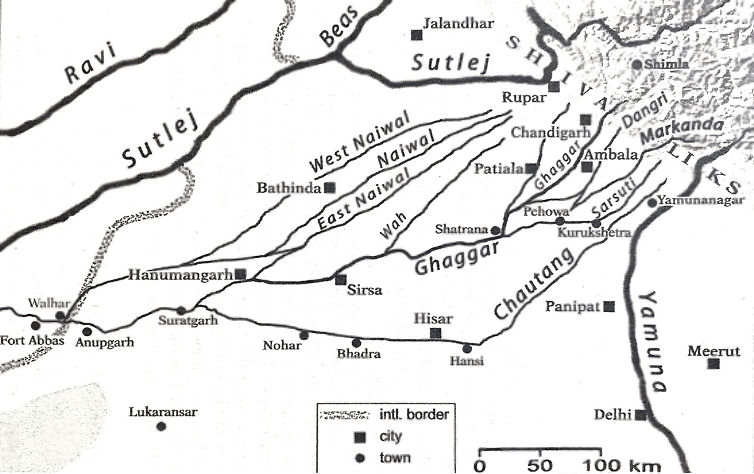
Now, the open question is that, which are those present day river(s) that was erstwhile known as Sarasvati. To answer this, we need to go back to the ‘Nadistuti Sukta’ of Rig Veda and when closely observed, the sequence of rivers mentioned in the hymn, is actually the order in which these rivers are geographically placed from east to west. According to the hymn, Sarasvati is supposed to be located in between Yamuna and Sutlej and if we consider the geological and archaeological findings and a little bit of map reading, we can find that the erstwhile Sarasvati is now the present day Ghaggar-Hakra river system. The origin and further route of the Ghaggar-Hakra river system corroborates with the placement of Sarasvati. The Ghaggar river that originates in the state of Himachal Pradesh and flows through Punjab, Haryana, Rajasthan and finally enters into Pakistan, joining the Hakra somewhere between Punjab and Haryana. We can also observe that along the path of the Ghaggar-Hakra river system, there lies several sites of Harappan civilisation which confirms the close relation between the river Sarasvati and the Vedic people from Harappan times.
The Harappan Connection
As we established that the Harappan civilisation, was to a large extent dependent on the river Sarasvati, we can also conclude that one of the reasons of extinction of these civilisation sites might have been the drying up of Sarasvati which might have been caused due the changes in the climate or even the great earthquake that occurred around 2700 BCE, which not only demolished the Harappan cities, but also most likely altered the path of the river which caused the people of the civilisation to relocate, abandoning their homes.
There is also a very interesting story in Hindu mythology describing how Sarasvati vanished. The story narrates that, Rishi Vyas who is considered to be the composer of the Mahabharat, requested Lord Ganesh to write the Mahabharat. They began the compilation of the epic on the banks of river Sarasvati which was flowing in all her might with a loud roar. While Rishi Vyas was dictating the Shlokas to Lord Ganesh, he found it difficult to concentrate and narrate the lines to Lord Ganesh due to the tremendously loud sound made by the river Sarasvati due to her majestic flow. Despite several requests which he made to Sarasvati, pleading her to calm down, she did not pay any heed to him and continued flowing with the same intensity which eventually made Rishi Vyas angry and he cursed Sarasvati to vanish from the face of earth. And thus, the river is said to have went underground and river bed dried up. Although this may just be a story, it overall connects with fact that the river once existed and it did dry up as the scientific studies also confirms.
I think it is safe to say that Sarasvati was indeed an integral part of the Harappan civilisation and it played a pivotal role in their day to day lives starting from providing water and various other resources to the settlements, to being an inspiration for composition of the most important texts of the Hindu religion – The Rig Veda.
The Amalgamation with Ganga and Yamuna
With all that we discussed and countless amount of data available through the studies and research performed by various eminent archaeologists and historians like Prof. B.B. Lal and Michel Danino (whose works were the base and inspiration for this article), it can be easily assumed that the river Sarasvati and the people of the Harappan civilisation were practically inseparable.
However, with the increase in arid region due to the steadily diminishing flow of water on the riverbed of Sarasvati, the Harappan cities saw the advent of eastward migration of people, where they found the other two sisters of Sarasvati still flowing – the holy Ganga and Yamuna. The new region provided a fertile ground for the civilisation to flourish. Although, the immigrants were not an ungrateful lot. Their loyalty towards their mother Sarasvati was proven, when upon reaching the confluence of Ganga and Yamuna, the migrants found out a convenient way to remember her, i.e. evoke her presence in the region of confluence, however an invisible one. Since then, the lost river, flows in a subtle invisible form, adding her sanctity to the other two and forming a holy trinity of river-goddesses, The Triveni Sangam, which became one of the locations for the famous Kumbhamela festival.
 Amit Kumar Hota
5 responses to “The Virtual Confluence: How Sarasvati Met Ganga and Yamuna in Triveni”
Excellent history. Keep it up.Stay blessed.
LikeLiked by 1 person
Thank you Mamu!!!
LikeLike
Stay blessed.
LikeLiked by 1 person
Wowwww. Now that is some extensive research work done. Kudos to the panaromic view point of your work towards Saraswati river. This article has made me nothing but more curious about the subject. Well done mate as always.
Can’t wait for your next history class…
LikeLiked by 1 person
Thank you very much my friend and I am highly obliged for your encouragement and trust in me! I hope I will continue to live up to the expectations.
LikeLike