
Prologue
It was the year 2001 when I was first introduced to one of the earliest, most advanced, yet mysterious civilisations of all. Although it was a brief chapter in one of our school history textbooks, it managed to sow a seed of curiosity in my mind. I was absolutely awestruck even by, however short read that it was, but it at least managed to paint a preliminary picture of how rich and advanced our Indian culture was since the protohistoric time, as opposed to the notion of Indians being poor and backward, which the British Raj made the world conceive about us when they invaded our country with their idea of ‘white man’s burden”.
It was a feeling of immense pride learning about my culture and its deep and ancient roots which went back beyond the 3rd and 4th millennia BCE. What was even more fascinating is that when the rest of the world could not even build basic houses, the people of Harappan civilisation were constructing cities with the level of town planning that can even make the modern towns of today look primitive. To say the least, a Harappan town had proper houses made of bricks, well laid streets and lanes, well planned sanitisation and drainage facilities. I immediately developed a deep rooted interest towards this civilisation and I wanted to learn more and more each day and I started searching for all possible sources where I could learn on the Harappan civilisation, their culture, the settlements built by them, their life during the period and basically, their whole history.
I began searching for any possible source of information through which I could learn more on the subject but back in 2001, when my hometown used to be small and even internet was not this common as today. But to my astonishment, I struck gold when I found a wonderful book, Lothal and Indus Civilisation authored by S. R. Rao at my home in my grandfather’s library. S. R. Rao was the archeologist who excavated the Harappan site at Lothal in 1954 for the fist time. This book contained overwhelming amount knowledge and insights on so many aspects of the Harappan civilisation such as the structures of their houses, their town planning, the potteries and ornaments, the seals used by them and their script, which is unfortunately yet to be deciphered. This was where I commenced my journey of exploring more on the history of the Harappan Civilisation a.k.a The Indus Valley Civilisation a.k.a The Indus-Sarasvati civilisation.
Understanding the Civilisation
Our understanding of this bronze age civilisation has evolved over time since it was first excavated by ASI in the year 1921 and all this research work by numerous archeologists until now has provided us a chance to take a peek into the past. The excavations of these sites has revealed that this civilisation was spread in a area as much as, if not more than the area jointly covered by the Egyptian or Mesopotamian civilisation. One can also argue that Harappan civilisation was much more advanced than the Egyptian and Mesopotamian civilisations. For example, where neither the Egyptian nor the Mesopotamian civilisation had proper town planning, the Harappan cities were seen to have systematically laid out, the streets being oriented along the cardinal directions (North-East-West-South). The excavations at Kalibangan in 1997-98 have shown that even the width of the streets were in a set ratio of 1:2:3:4. There was also found an elaborate system of underground drainage which the other contemporary civilisations could not even dream of at that period.
The excavated sites also showed that the cities had majorly two components:
- The Citadel – A relatively smaller structure in the centre, meant for the elites, priests and rulers. Inside this area lay many important buildings such as, the granary, a bath complex and the platforms carrying on them religious structures of various denominations.
- The Lower Town – The bigger area surrounding the Citadel, inhabited by the commoners and was fortified with an outer wall
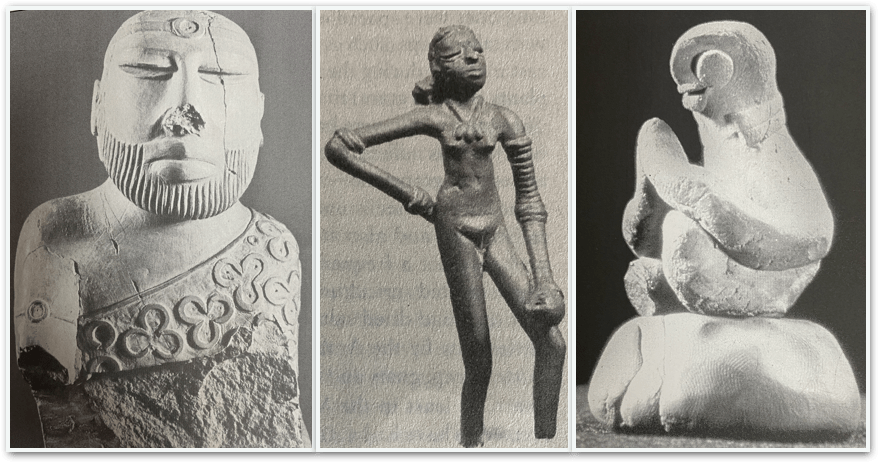
There can also be seen use of kiln-fired bricks made in a set proportion of 4:2:1 (40 cms x 20 cms x 10 cms or 30 cms x 15 cms x 7.5 cms), which was another feature that made Harappan towns unique from their western counterparts. Although, there was no large-sized sculptures found in an of the cites like that in the Egypt and Mesopotamia probably due to the fact that there was lack of availability of stones in the alluvial plains of Indus and Sarasvati river.
The earlier excavation along the Indus river did brought up numerous sites of this civilisation, the important ones being: Harappa, Mohenjo-Daro and Chanhu-Daro along the Cholistan desert in now Pakistan. However, there are numerous sites in India along the erstwhile prominent water system, the holy river Sarasvati, which dried around 1900-1200 BCE. But, before drying, it used to be a major river which holds the stature of a goddess in the Hindu religion and is described in the Rig Veda as ‘Naditama’, meaning the best of all the rivers. Along this river are situated numerous sites running from North to west in Gujarat where the Sarasvati drained into the Rann of Kutch. The largest sites of them are Rakhigarhi in Haryana, Kalibangan in Rajasthan and Lothal and Dholavira in Gujarat. The sites along the Sarasvati basin are also more important because they corroborate to the existence of the river Sarasvati and also provides the idea of the possible authors of the Rig Veda.
The Evolution of Civilisation Along the Sarasvati Basin
There are clear signs of a continuous evolution of civilisation in the Sarasvati basin. Its first occupants started with dwelling in pits around the 5th millennium BCE upto the time when they started building fortified and highly prosperous cities in the 3rd millennium BCE. There are no signs of any breaks seen in this evolution and nor is there any evidence of infiltration of people from an alien culture.
This evolution can be broken down into four stages based on the continuity of evolution in the culture and life of the inhabitants:
- Stage I: The Pit Dwellers (5th Millennium BCE):- As the name suggests, at this stage, the people used to live in circular pits of various sizes ranging from 2 M to 3.4 M in diameter and 34 Cms to 1 M in depth which was adequate to accommodate a couple and 1-2 children at best. This type of settlements were found in Bhirrana and Kunal region in Haryana and Cholistan region in Pakistan. The pit walls and floors were found to have been lined with either mud plaster or mud bricks. The dwelling pits were complimented by another smaller pits which were used for cooking, sacrificial, and even industrial purposes.
The pit dwellers had stepped into the ‘Copper Age’, as bangles and copper arrowheads were found from the pits. Fragments of crucibles with specks of molten copper were found in one of the pits. The inhabitants also seemed to have been making and using ornaments as beads of semi-precious stones such as: Agate, Carnelian, Jasper and Lapis-Lazuli were found. Fish hooks made of copper were also found which also suggests that they also had fish in their diet.
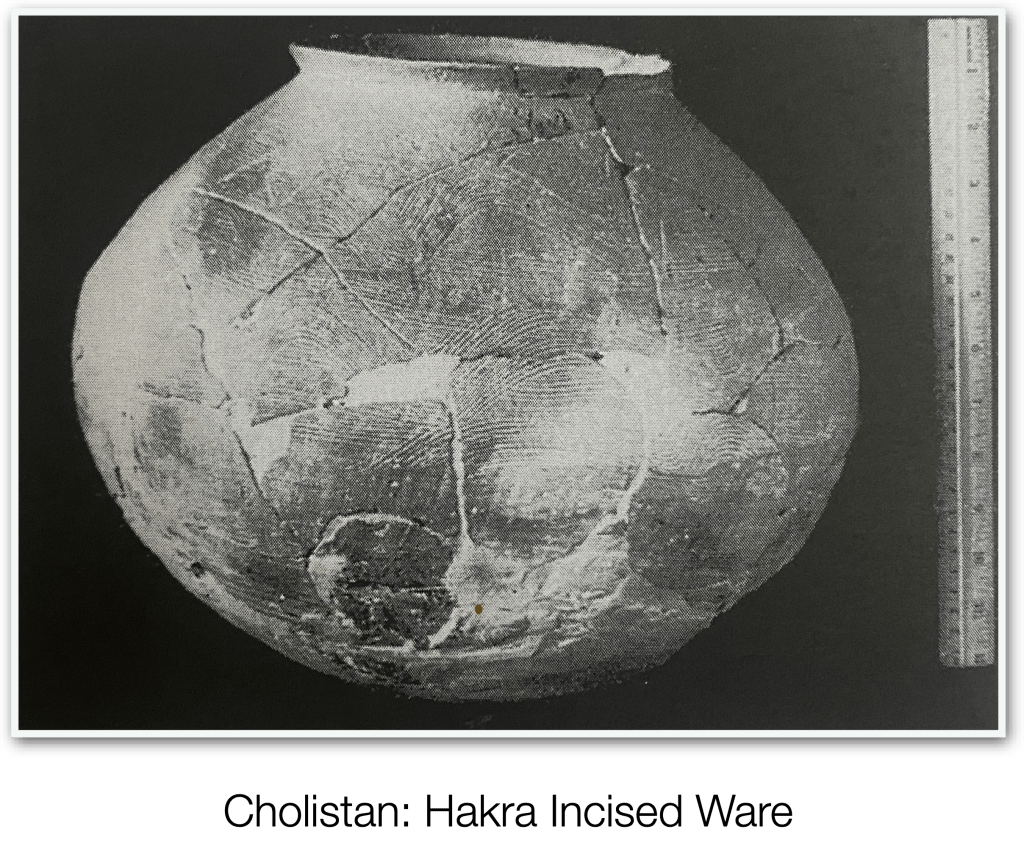
They also seemed to have used a distinctive type of pottery which was named ‘Hakra Ware’, as it was first found in the Cholistan region of Pakistan, where the dried-up Sarasvati river goes by the name of Hakra. However, it was noticed that the use of Hakra Ware was diminishing with increase of Bi-chrome Ware in which 2 colours were used, black and white.
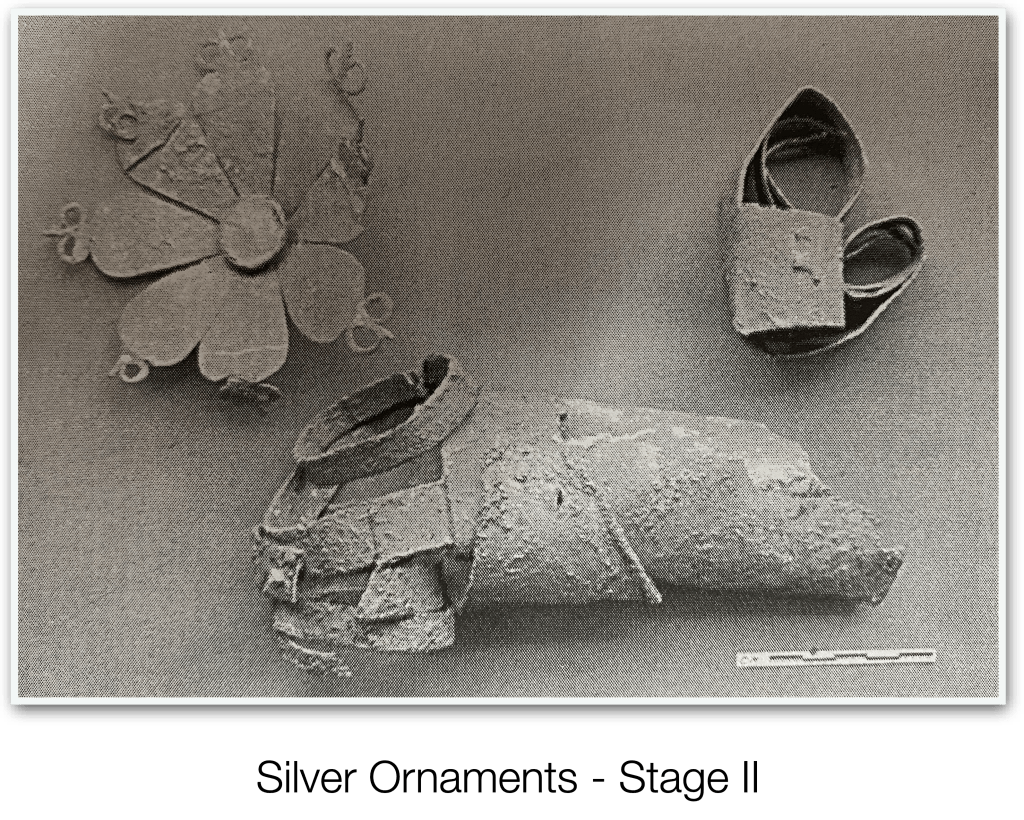
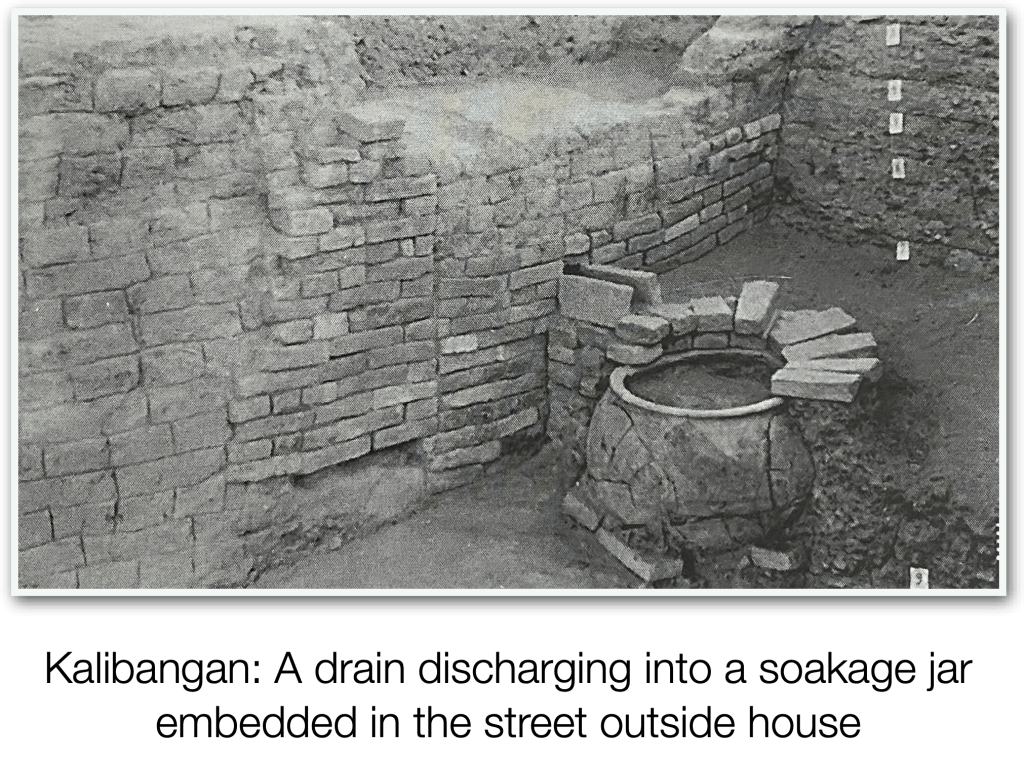
- Stage II: Emerging Out of The Pits (4th Millennium BCE):- With the passage of approximately a millennium since Stage 1, the pit dwellers started building houses above the ground surface, possibly due to the increase in the need for space and inconveniences owing to the restricted areas within the pits. This type of settlements were found in Bhirrana, Kunal, Rakhigarhi and Dhalewan. The houses were made of mud bricks, measuring at the ratio of 1:2:3 or 1:2:4. However, still there was no peripheral walls found around the houses. The dwellers also seemed to have become conscious of drainage as there we soakage jars found fixed as necessary.
There were also signs of boost in prosperity among the inhabitants as large number of beads of semi-precious stones and many objects and ornaments of made of copper, silver and gold were recovered from the sites.
In the Rakhigarhi, one of the largest sites of Harappan civilisation, the houses seems to have been oriented along the cardinal directions and a lane measuring 1.8 m was also identified between 2 houses, along which a drain made of kiln-fired bricks was found. Here, the houses were planned with a central courtyard surrounded by living rooms, a pattern which continued upto Stage IV of evolution.
- Stage III: Emerging Out of The Pits (Last Qtr of 4th Millennium BCE):- This was when the people of this period started building peripheral walls around the settlements however, no clear purpose of the wall could be determined till date. It could not even be argued that the purpose of the wall was to safeguard the settlement from enemy attacks as there was no evidence of any attacks or wars found in and around the sites.
The brick size ratio was largely similar to that of the earlier stages i.e. 1:2:3 and more frequent use of kiln-fired brick could be seen in the sites of Stage III. The type of pottery too was carried on from the previous stages but it also adds on the additional elements and shapes which would also be found in the potteries of Stage IV.
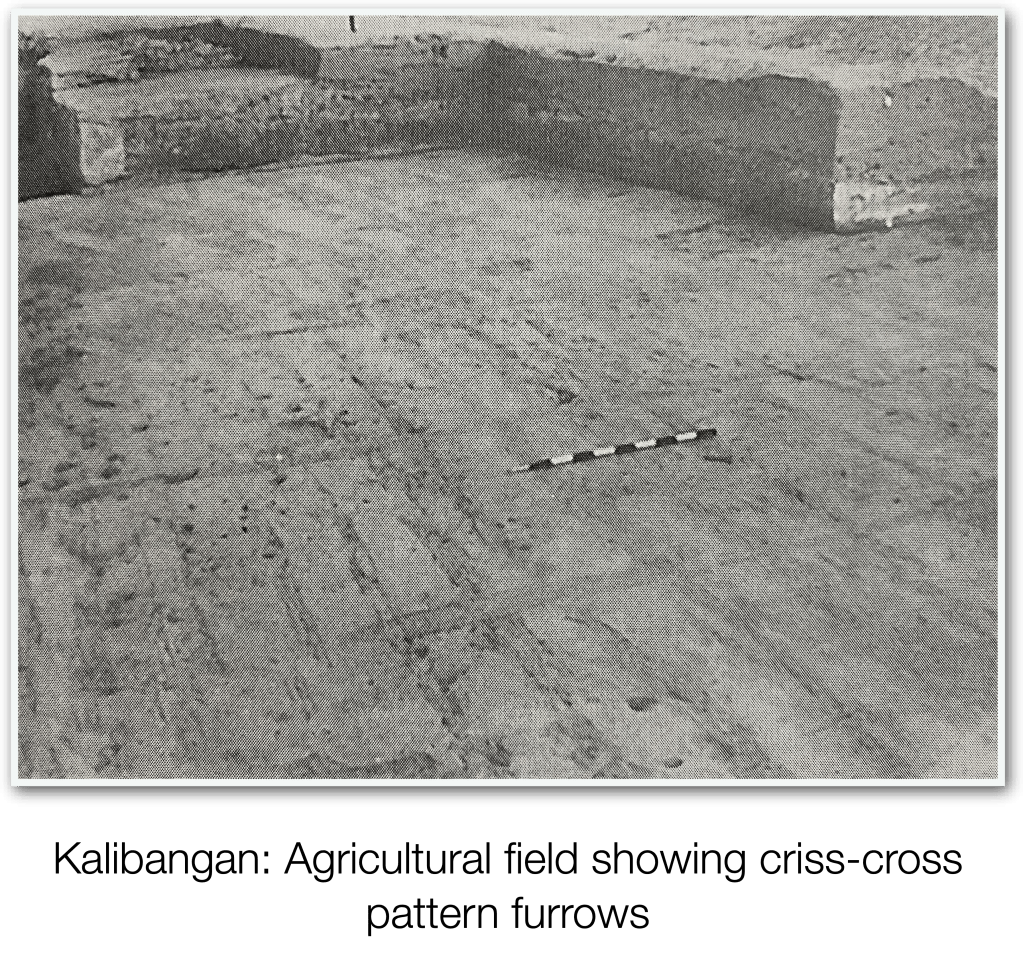
Ploughed agricultural fields with criss-cross pattern furrows were also found in Kalibangan site which suggests that those ancient people were also good at farming as the same ploughing technique is still in use by modern farmers.. Although it was seen that the Stage III settlement at Kalibangan came to a sudden end due to an earthquake around 2700 BCE, signs of which were observed at many places in the excavated site.
- Stage IV: Full Fledged Urbanisation (2700 BCE – 1900 BCE):- The concept of 2 part settlement had emerged, namely a ’Citadel’ or an ‘Acropolis’ and a ‘Lower Town’, about which we had already discussed in the previous section. Both the sections were contiguous to each other with a common peripheral wall encompassing the whole settlement. The houses were made of mud bricks and one of them had a toilet with a wash basin placed at a high place in a corner near the drain which carried off the waste water into a sullage jar placed outside on the street.
Another one of the houses was discovered with gold beads, Carnelian, Lapis-Lazuli etc. besides tiny weights. There was also discovery of a touchstone bearing gold streaks of different hues and as it turns out, touchstones are used for testing gold purity even till date.
Also, the site of Kalibangan which had been abandoned back in around 2700 BCE due to the earthquake, was occupied again after a century around 2600 BCE. By this time, the concept of settlement was changed upon repopulation of site with the clear division of settlement in two parts, the Citadel and the lower town with a common fortification around the settlement.
The Religious Connection and The Economy
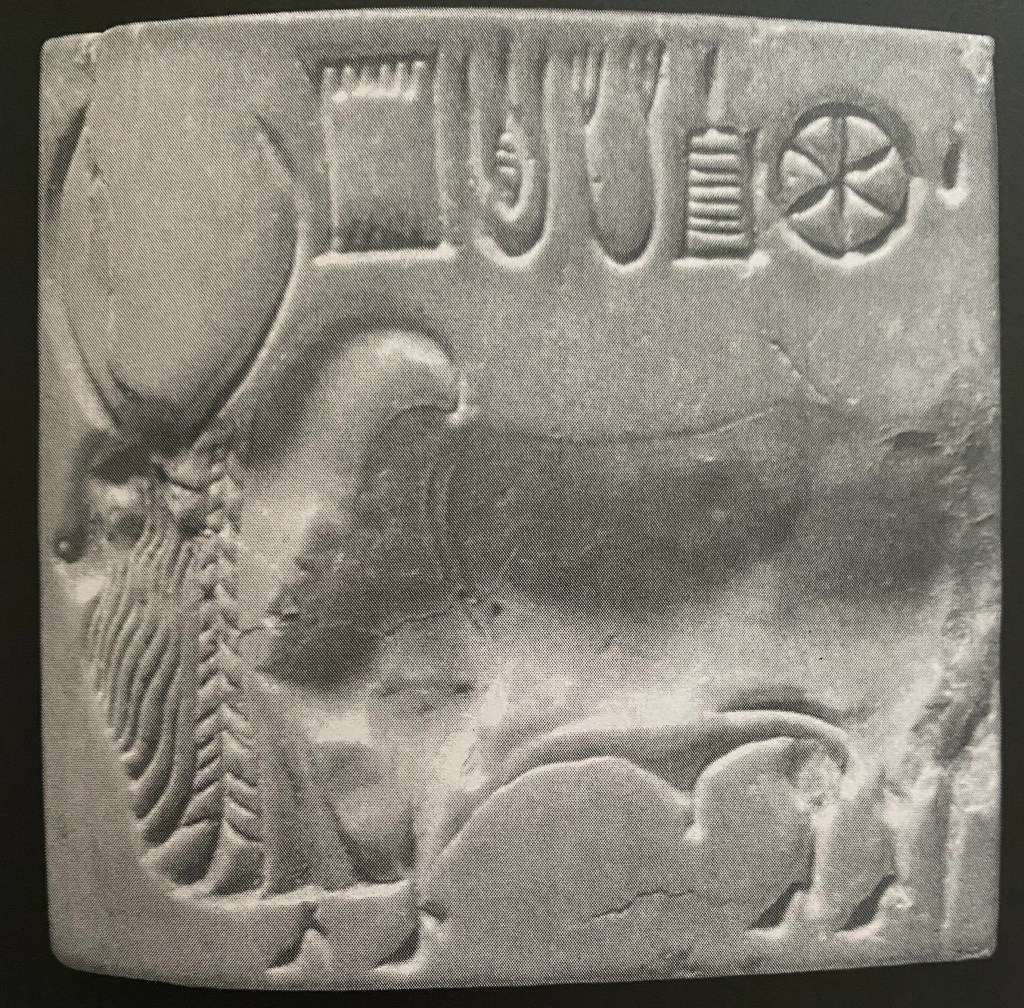
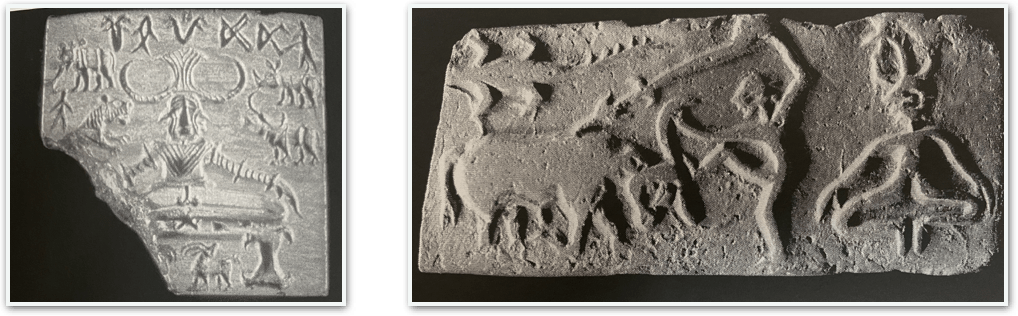
The people of Harappan civilisation seemed to have deep and elaborate religious culture which seemed to be very closely related to the present day Hinduism. The seals found in the excavated sites have depictions of horned deities, believed to be of Lord Shiva. There were also signs of existence of animal sacrifice found in the seal where a man is depicted piercing a spear through a buffalo for offering to the horned deity.
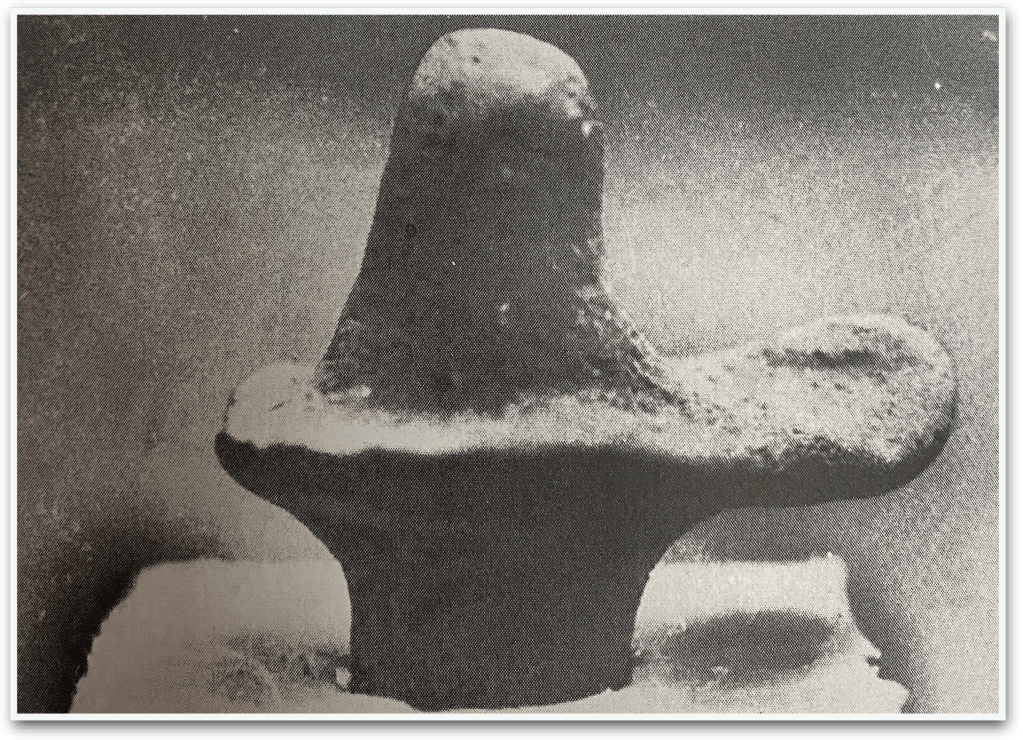
Yonis and lingas made of stone were also found in Mohenjo-daro and Kalibangan which is worshipped by Hindus till the present day as the symbol of Lord Shiva.
There are also traces of tremendous amount of trade of agricultural products, potteries and ornaments within the other settlements and also with other civilisations outside India such as, Mesopotamia, Egypt, Sumerians etc. The objects from the Harappan origin have been found during the excavations of these sites of other civilisations. It is also likely that the various kinds of seals found in the Harappan sites were used for various purposes in trading.
Summing It All Up
There have been many civilisation across the globe but the Indus-Sarasvati civilisation is not like any other civilisation. The Harappans were amazingly advanced and ahead of their time with their elaborate town planning, drainage and sanitation, their properly made houses, the modern agricultural practices and their intricate work of art and crafts.
What we could also see that how the culture and many other practices such as the basics of town planning, the measurement ratios of bricks which were followed by the Harappans are still being followed to this day.
There is still a lot to be discovered about this fascinating civilisation and there are numerous truths yet to be unearthed and many more myths yet to be debunked which would make our country and our roots even stronger. I also hope that I would someday get to visit each of the sites related to the Harappan civilisation and get a peek into our past up close.
I will also be writing on more of the facets of this civilisation in my upcoming blogs, so I would urge the readers to keep an eye out for them to learn more in details about this ancient civilisation and the time period.
Work cited: The Rigvedic People – B.B. Lal; The Lost River – Michel Danino
 Amit Kumar Hota
2 responses to “Harappan Civilisation: The Real Treasure of India”
The ease of writing is much appreciated for such a subject. The topic is enriching, intriguing and above all fascinating.
Well done for bringing this in light in such a beautiful and reader friendly way.
LikeLike
Much obliged for the feedback and that you took time out of your busy schedule and went through the article
LikeLike